
Defining Thomism
ISTA. Lecture 14. On the kind of definition to be attempted and its attempt fulfilled.

[The study of truth is a spiritual discipline, and theologians are borne on their knees. I instruct the reader to begin this, and every lecture, by elevating his mind to God. I suggest Saint Thomas’ Prayer Before Study.]
In last week’s lecture, Thomism Recovered, I finished proposing to my reader a three-part exposition on the History of Thomism. Today, we return to the question What is Thomism, and attempt a real definition.
What kind of definition?
We have seen the nominal definition of Thomist — a follower of Thomas Aquinas. Now, we will pursue a real definition. It is sometimes the case that people think that there is only one possible real definition. But that is not the case, as the following chart renders evident.1
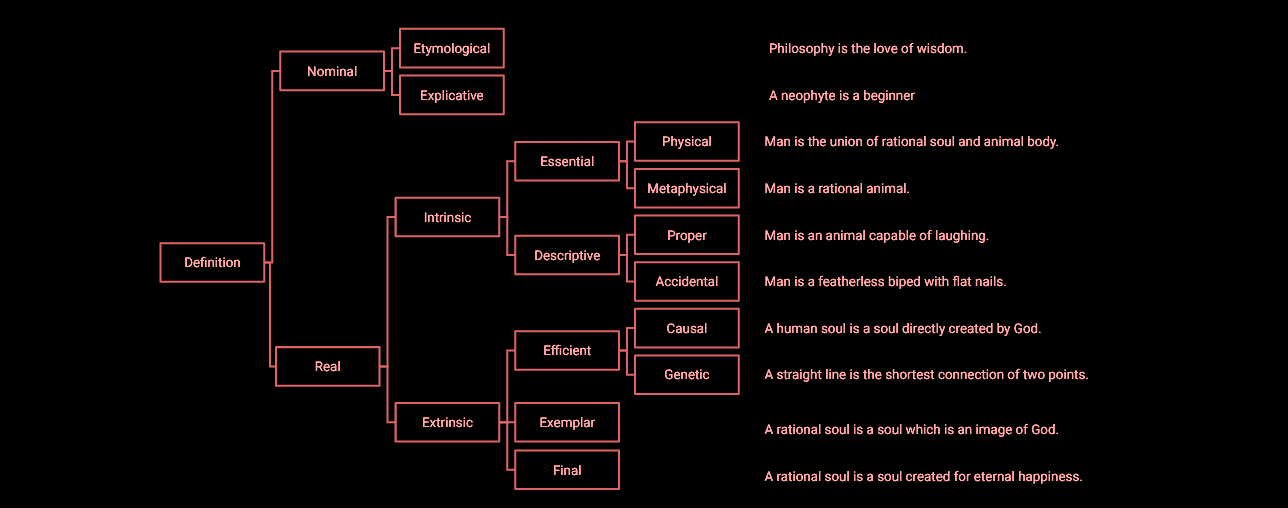
The best kind of definition is a metaphysical definition. It is to it that we must aim. However, it is also the most difficult to attain. Therefore, I will first procure a descriptive definition. Bear with me.
Accidental Descriptive Definition
A descriptive definition, as the chart makes evident, is an intrinsic, but not essential definition. Thus, it renders clear the meaning of the thing to be defined by means of some intrinsic, yet not essential, features. This can be done either by things which necessarily follow from the essence—in which case the definition would be made by properties, and so be called a proper descriptive definition—or by things which follow from the essence contingently—in which case the definition is made by accidents, and so is called accidental descriptive definition. I am now proposing the second.2
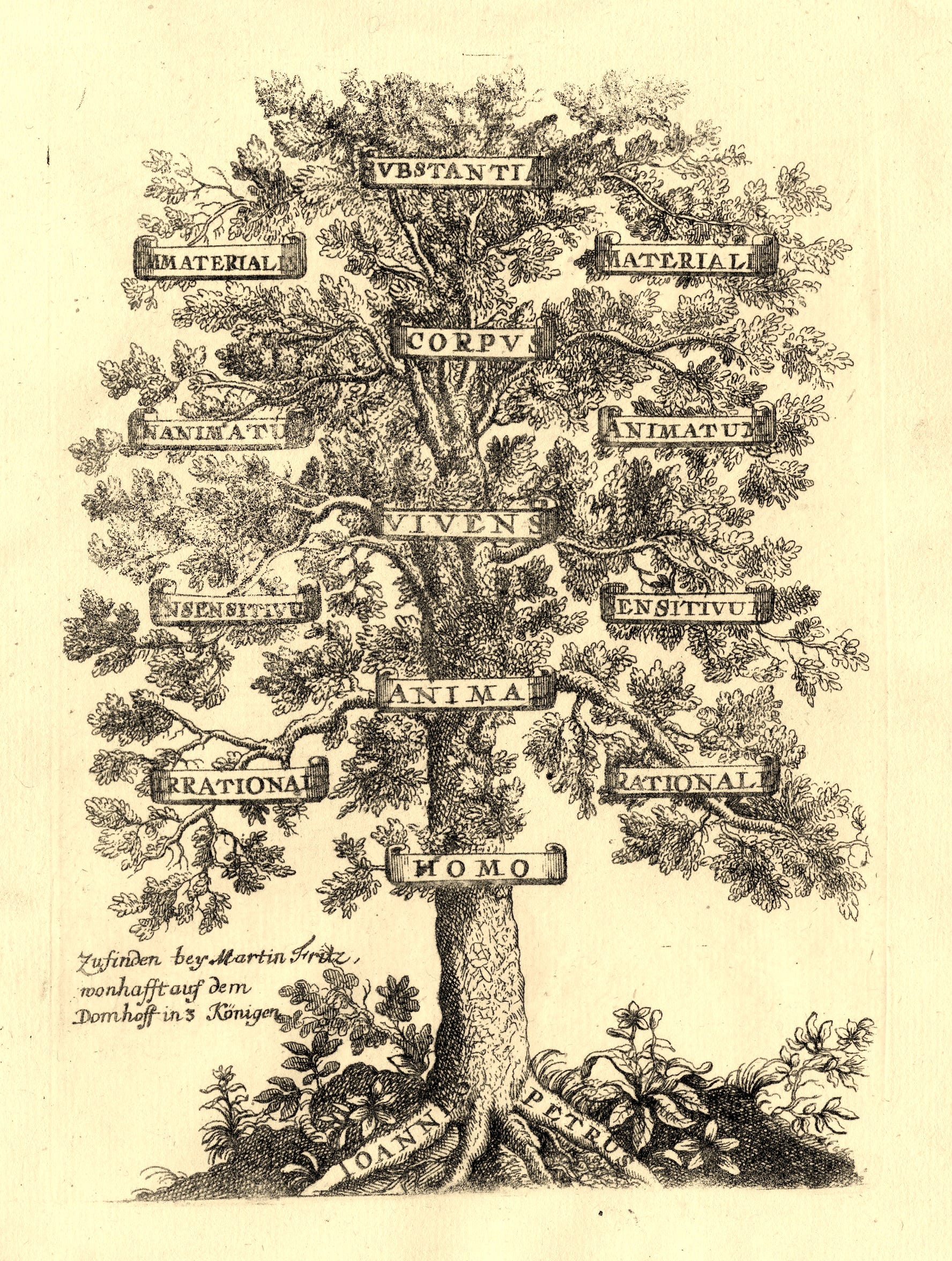
Any real definition, no matter how imprecise it may be, requires the assembly of two elements. First, a more general category, which is part of the definition, but ought to be further determined. It ought to be further determined by the second element, which differentiates it from other things inside that same category. The result of crossing these elements is something specific, which ought to be convertible with the definition.
For instance, as the reader may know, the usual definition of man is rational animal. Here, man is the more specific thing attained by crossing a more general category (animal) with a differentiating feature (rational) of the thing to be defined.
To the specific thing attained (in the example, man) we call species;
Whence the term “specific” comes from.
To the general category (in the example, animal) we call genus;
Whence the term “general” comes from.
To the differentiating feature (in the example, rational) we call differentia.
Whence the term “differentiating” comes from.
Let us now apply this to Thomism. It can be said that Thomism (species) is the set of propositions (genus) that satisfies the following conditions (differentia).
It includes all the propositions which were foundational to the thought of Saint Thomas Aquinas;
It includes all propositions which, while not included in the previous,
can be logically deduced from those;
result from their application to new empirical discoveries.
It includes no other propositions.
None of these conditions is without difficulties. A great many Thomists disagree regarding which propositions fit condition 1. To give my reader an example, while Jacques Maritain and Norris Clarke seem willing to reduce the number of predicaments (which Aristotle and Aquinas count to be 10), most (if not all) neo-scholastic Thomists would find this suggestion preposterous.3
Once one has dealt with historico-exegetical features of Aquinas’ texts, condition 2 is the meat and bones of a Thomist’s activity. We exchange papers debating some of these topics. Of course, this implies a development of Thomism. But there should be no problem with that. It is evident that Aquinas himself did not think he could never err. To paraphrase his teacher, Albert the Great, regarding Aristotle, “as I never thought him to be God, I never thought him to be always right.” And, indeed, it is not even a matter of being wrong. Many times it is just a matter of being silent.
Some of these new propositions get so well established that most Thomists will simply regard them as pertaining to condition 1, but one must be careful to distinguish the waters here. For instance, the distinction between pure and mixed perfections, or between ratio formalis qua obiecti and ratio formalis quae obiecti (“formal reason of the object by which [something is attained]” and “formal reason of the object which [is attained]”), while not explicitly in Aquinas, are distinctions which necessarily follow from his writings.
Following condition 2, Thomists ought to be careful not to get too enthusiastic about the discoveries of contemporary science. It is a different species of science (or even from an altogether different genus), so that its method is much different from the philosophical and theological one, and so the meaning of many terms. Nonetheless, natural philosophers ought to be guided by two important principles: Ockham’s razor (which is much older than Ockham—a common mistake of modern academia),4 and saving the appearances.
Ockham’s razor claims that, when looking for an explanation for X, one must not postulate more principles than those strictly necessary;
“Saving the appearances” claims that, when looking for an explanation for X, one must always assume that X is as it seems to be, unless that would make it impossible to find an explanation.
Finally, regarding condition 3, it does not mean that a given Thomist can hold to no other proposition. But it means that holding other propositions is not something that the Thomist does inasmuch as he is a Thomist. For instance, “Portugal is the country which should win the World Cup” is not a proposition I hold inasmuch as I am a Thomist, but it is a proposition which I, a Thomist, hold.
Metaphysical Definition
My reader, however, may be somewhat troubled that I am proposing to define such a noble thing as Thomism as a mere set of propositions. It is a troublesome thing indeed. However, my reader must remember, this proposal was of an accidental definition (and an imprecise one, for that matter). I will now propose a metaphysical definition. However, in order to do that, I will need to make two explicative excursus.
Two Explicative Excursus
For the trained philosopher, what follows are very simple claims. For the beginner, however, (and so I take my reader to be) these are fundamental ideas. The first is that words can have meanings somewhat different, while not completely different. The second is what virtue is.
First Excursus: Analogy
When using the same term twice, sometimes it means exactly the same thing. For instance, when I say that both pigs and bulls are animals, animal is applied to both in the exact same way. We call this univocity, and say that the term was used univocally.
But this is not always the case. For instance, the word bank can mean both a place to store money and the terrain that borders a river; bat can mean a flying mammal or a wooden stick used in some sports. We call this equivocity, and say that the term is used equivocally.
Now, there is no middle point between “the same” and “different,” and so there is no third option between a term signifying the same and it signifying different things. However, there is a middle point between “the same” and “completely different,” and so there is a third option between univocity and pure equivocity. We call it analogy.
Some examples of analogy are man said of Lincoln and its statue; angry said of a mother and the sea; healthy said of urine and an animal; true said of things and propositions; and principle said of the premises in relation to a syllogism and a point in relation to a line.
Second Excursus: Virtue and Science
Substances have qualities. There are some kinds of qualities. One is called disposition. It is a quality which disposes its subject. It disposes its subject towards some operation. If this disposition is stable (i.e., difficult to lose), it is called habitus, which is usually translated as habit, but means rather had. A habitus, generally speaking, is something had. As a kind of quality, it means a quality that you have and that disposes you towards some operation. If it disposes you to perform an operation well, it is called a virtue. If it disposes you to perform an operation badly, it is called a vice.
So, for instance, honesty disposes you towards acting well in regards to telling the truth; courage disposes you towards acting well in regards to dealing with fear; and so on.
Now, knowing is also an operation, and so not all virtues and vices are purely moral, but some are rather intellectual. Some examples of intellectual virtues are wisdom, art, and science.
Definition of Thomism
Let us now bring the dots together. The term science can mean the virtue by means of which one is well disposed towards the following operation: knowing something by means of its causes. However, the same term can also mean the set of propositions at which one can arrive by means of said virtue. The term science signifies both analogically.
Similarly, the term Thomism can be used to refer to both the set of propositions described above, and the inner quality (or, to be more precise, a set of coordinated qualities) that allows one to arrive at them. This double-sense is similar to the one existing in the word worldview, which can refer to what is viewed (the set of propositions) and the quality of the viewer (the virtue).
Also, like any other habit, Thomism is a second nature. The core idea here is that, just like natures are inner principles of action (e.g., fiery things burn; icy things cool; rational things reason), so things possessing a habit will act accordingly. Thomists constantly do some kinds of operation. We see the world in a specific different way.
How do Thomists see the world?
Some weeks ago I shared with my reader the triple question that drives every scholastic research: an est (whether it is), quid est (what it is), and quale est (how it is). To ask how Thomists see the world means to ask the quale est question. Our whole Course on Thomistic Philosophy, already ongoing, is a very long answer to it.
Nonetheless, the following can be said, as a synthesis of a synthesis of a synthesis of a synthesis.
First, Thomists believe that the things they perceive with their minds exist in reality. We call this realism. However, Thomists believe that these things, existing both in mind and in reality, exist in each differently (for instance, in the mind universally, but in reality singularly). Thus, our kind of realism is called moderate, or critical.
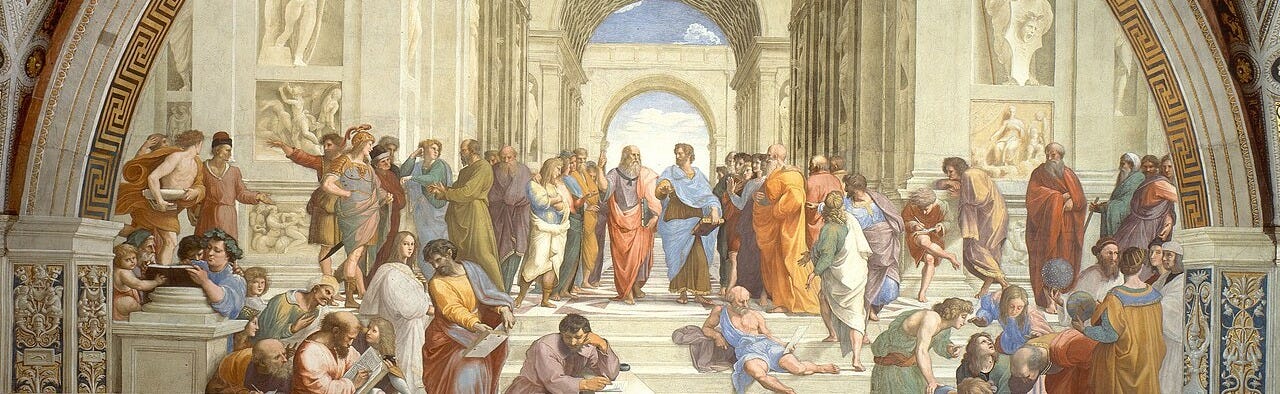
Secondly, Thomists hold that being is the first thing conceived by the intellect, and that from it the mind intuits the principle of non-contradiction—to wit, that the same cannot be both affirmed and denied of the same thing at the same time and in the same sense. We hold that this and many other laws (which all can be reduced to this, at least per absurdum), which are called laws of reason, are also, and foremost, laws of reality. Other similar laws include the principle of the excluded middle, and the principle of reason of being, and the principle of causality.
Thirdly, Thomists hold that the most perfect knowledge of a thing is to know not only that (quia), but rather the why (propter quid). Accordingly, we hold that knowledge is perfected by investigation towards the causes. A cause is that from whose being the being of something else follows. But we understand this in a fourfold general manner, and so we hold for four genera of causes:
Two of which enter into the composition of the thing itself (the effect), and so are called intrinsic causes:
the material cause: that out of which something is made, or that in which something is made; and
the formal cause: what the thing is, or the configuration of its matter;
And also two which do not enter into the composition of the effect, and so are called extrinsic causes:
the efficient cause: which is that which made the effect, and is what moderns usually mean by cause; and
the final cause: which is the purpose, or natural inclination, of the effect.
Quite evidently, there are many other things to which Thomists hold. We believe in the existence of One God in Three Persons. We hold that the mind can be aided in its efforts from without, by gifts of grace. And so on. We hold fiercely to many more principles of reason than those mentioned above, and to everything which we take to follow necessarily from them. And we hold with caution to other things which, while not following necessarily from the principles of reason (nor from the principles of faith), nonetheless seem to be implied by them.
Others try to sell you cheap Thomism.
Consider supporting my work:
a grounded, rigorous, living, and respectable Thomism.
Today I have attempted at defining Thomism. It was a laborious task. Next week I will suggest my reader some means by which he may become a Thomist himself.
Gonçalo Costa
The Respectable Thomist
The day will come in which my reader will be given the definitions of all these kinds of definitions. But each day has its labor, and each its glory.
Two things ought to be noticed. First, “property” has a technical meaning, much different from the usual meaning of the word in modern day English. It means, as I said above, something which is outside the essence, but necessarily follows from it. It is sometimes called a “proper accident,” since, following the ten predicaments (also called categories), it is an accident. Therefore, the “accidents” referred to in the accidental definition must be understood as non-proper accidents.
In fact, most queries about “who counts as a Thomist” have to do with this first condition. About the second, Thomists may disagree without issuing excommunications.
Aquinas himself applies this principle in ST, Iª, q. 2, a. 3, obj. 2. Another striking example of this academic snobbery are De Morgan’s laws. Attributed to Augustus De Morgan (1806 - 1871), these laws were already applied in Scholastic Logic, more than two centuries before Mr. De Morgan was born.