
On the Genesis of Thomism
ISTA. Lecture 11. A Brief History of Thomism, part 1: from 1274 to 1400
[The study of truth is a spiritual discipline, and theologians are borne on their knees. I instruct the reader to begin this, and every lecture, by elevating his mind to God. I suggest Saint Thomas’ Prayer Before Study.]
In last week’s lecture, On Thomism: Whether there is such a thing, I have begun a multi-part introduction to Thomism. As I explained there, the proper scholastic method of analysing a thing considers three questions: whether that thing exists (an est), what it is (quid est), and how it is (quale est). Last week, I dealt with the first and started answering the second. We now continue that journey. To do that, I will propose to my reader a brief exposition on the History of Thomism, divided into three parts:1
From 1274 to 1400 — the forge of Thomism;
From 1401 to 1800 — the Golden Age of Thomism;
From 1801 to the present day — the recovery of Thomism.
General Overview
The period we are covering today starts in 1274. To be more precise, it starts on March 7th, 1274, that is, the day of Saint Thomas’s death. However, the reader must not think that, once Our Doctor died, a school of thought was instantaneously born. Quite the contrary, it took time for this school to be formed, and for its members to be self-conscious of belonging to a school.
At the end of the period we are considering, for a brief moment, Thomism seemingly disappeared. Why?
Between 1347 and 1353, Europe was devastated by the Black Plague, with approximately 100 million deaths. The fear caused by this event brought up a massive disruption to the intellectual, religious, and spiritual life. And so, irrationality and anti-intellectualism prevailed.
Between 1309 and 1377, the Pope was held hostage in Avignon, and, from 1378 to 1417, there were two, and eventually three, simultaneous claimants to the Papacy. This led to a great division in the Church, with members of the same order, religious community, and university supporting different popes. This partially led to a practical scepticism on the value of authority.
At the same time, there was a great rise of Nominalism in all important universities, which was received as a new, modern system, with great consequences for Law, Morality, Politics, etc. Furthermore, the Dominicans were expelled from the University of Paris around 1387, due to a conflict around the Immaculate Conception.
All of this led to the decadence of the Dominican Order, which in turn led to a brief disappearance of Thomism.
In today’s lecture, we will succinctly cover the following:
The Continuationes of Aquinas’s works;
The Apologiae and Concordantiae;
The First Thomists;
The Polemics around the Immaculate Conception;
Some theses which are characteristic of this period.
The Continuationes of Aquinas’s works
Aquinas died on March 7th, 1274. Being around 49 years old, he left many of his works unfinished. It was the task of his followers to complete his works.
His Summa Theologiae was completed by fr. Reginald of Piperno, O.P., who was the Saint’s secretary during his life, and, after the death of Our Doctor, was appointed, first, Master of Theology, and, in 1275, bishop.
His Disputed Questions on the Power of God were mostly finished, but there was an incomplete section,2 which was completed by fr. Vincent of Castronuovo, O.P., who was born, strictly speaking, after the period we are considering, in 1435, and came to be the General Master of the Dominican Order.
His Disputed Questions on the Virtues were similarly completed by fr. Vincent.3
His Commentary on Aristotle’s Meteorology was completed anonymously. Scholars think it might have been Peter of Alvernia, a secular priest who was the rector of the University of Paris by 1275, and later bishop of Clermont.
His Commentary on Aristotle’s On Interpretation received several completions. Some influential examples were: fr. Gratiadeus Aesculanus, O.P., fr. Thomas of Sutton, O.P., and fr. Thomas de Vio, O.P. — mostly known as Cardinal Cajetan. The latter’s was the most influential.
His Commentary on Aristotle’s Politics was completed by Peter of Alvernia.
His commentary on Aristotle’s On the Heavens was also completed by Peter of Alvernia.
His commentary on Aristotle’s On Generation and Corruption was completed anonymously.
His On Kingship was completed by fr. Bartholomew (or Ptolemy) of Lucca, O.P., who came to be bishop of Torcello.
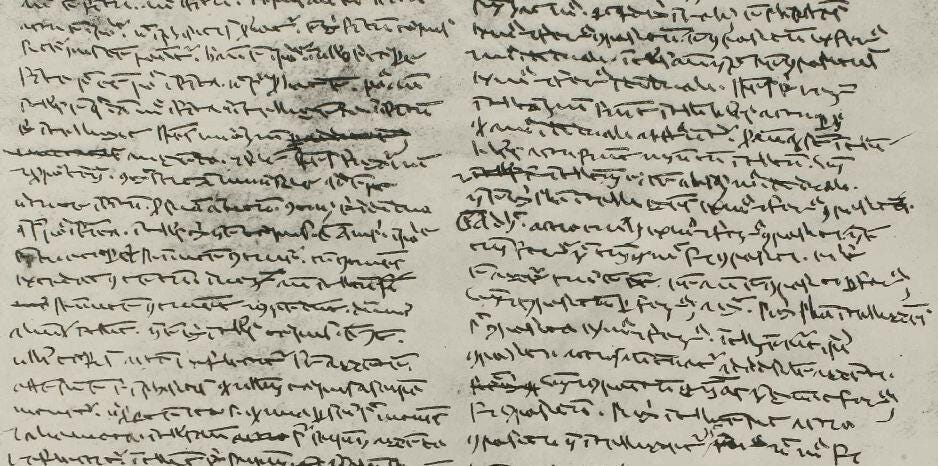
Besides these continuationes, there were also some works attributed to Aquinas which are at best dubious, and at worst inauthentic. The one most well known today is De Modo Studendi, a small booklet with some tips on how to study. Those most influential during this period were :
the Pertransibunt Plurimi, written by fr. Thomas of Sutton, O.P., which would be a later text from Saint Thomas retracting from some previous positions (similarly to Saint Augustine’s Retractationes);4
some logical works, such as On the Nature of the Genus, On the Principle of Individuation, and Summa Totius Logicae Aristotelis (Summa of the Entire Logic of Aristotle). Particularly the latter (anonymous, but some scholars point to Thomas of Sutton) was very influential, particularly on John of Saint Thomas’ Logic.
The Condemnations of 1277 and the Correctoria
Previously, we have covered these condemnations and the Correctoria that come from it. However, let us now, briefly, indicate some theses that can be attributed to Aquinas and which were condemned.
Examples from the condemnations of Paris (March 7th 1277)
The first cause (= God) cannot make more than one world:
The condemnation worries that, in holding this, philosophers are limiting God’s omnipotence;
Aquinas argues so, e.g., in ST, Iª, q. 47, a. 3.
Aristotle’s arguments demonstrating that the motion of the Heavens is eternal are not fallacious:
Note that the condemnation does not only claim that the motion of the Heavens is not eternal;
Aquinas holds this, e.g., in ST, Iª, q. 46, a. 1.
God cannot multiply individuals under one same species without matter;
This implies that there cannot be two angels of the same species, and so St. Gabriel and St. Michael do not differ as John and Peter, but as cat and dog;
Aquinas argues for this, e.g., in ST, Iª, q. 50, a. 4.
It is problematic to suppose that some human intellects are nobler than others;
The condemnation worries that, in this way, Christ’s human intellect is as noble as Judas’s;
Aquinas seems to hold this thesis in ST, Iª, q. 85, a. 7.
Examples from the condemnations of Oxford (March 18th 1277):
Matter has no active potency:
Held by Thomas, for instance, in ST, IIIª, q. 32, a. 4;
The intellectual soul, when introduced in a body, corrupts the sensitive and vegetative souls:
The thesis presupposes the medieval theory of progressive animation, according to which the embryo would, at conception, receive a vegetative soul, and then a sensitive soul, and finally an intellectual soul;
Aquinas’s point is that these souls do not coexist, but that the coming of one means the corruption of the other — he argues for this, e.g., in De Potentia, q. 3, a. 9, ad 9.
“Body” is predicated of a living body and of a dead body equivocally:
The condemnation worries that the body which stayed in the tomb would then not be Christ’s body properly speaking;
Aquinas argues for this thesis, e.g., in ST, IIIª, q. 25, a. 6, and q. 50, a. 5.
The Apologiae and Concordantiae
The Apologiae
Some zealous theologians wrote some Correctoria (singular: Correctorium) Fratris Thomae, in which they argued that this or that thesis was problematic, and corrected it. The most famous one came to be that of fr. William de la Mare, O.F.M. Its first redaction (c. 1277-1282) “corrected” 118 articles; its second and last redaction (c. 1287) “corrected” 138 articles.
It did not take long for the Dominicans to start writing some defenses of Aquinas. These would usually be named something like “Apologia”, or else, jesting with the Correctoria — which they considered “Corruptoria” (i.e., corruptors of Aquinas, rather than correctors) —, “Correctorium Corruptorii” (the corrector of the corruptor). Their goal was to show Aquinas’s orthodoxy, and the truth of his thought.
The most influential were the following (named after their first word):
Correctorium Corruptorii ‘Quare’, by fr. Richard Knapwell, O.P.;
Correctorium Corruptorii ‘Sciendum’, by fr. Robert of Oxford, O.P.
The name “Thomists”
This controversy gave rise to the name “Thomists,” as referring to the group of followers and defenders of Aquinas. The first reference we have to such a group is in a letter of Pietro di Giovanni Olivi, from 1283 — he has no word for this group. In 1304, Giacomo Albi di Digna and Arnaldo di Villanova use the word “Thomatistae” (singular: Thomatista). Before 1337, however, we find the name “Thomistae” (singular: Thomista) circulating, in a letter from fr. Peter of Tornaparte.
The Concordantiae
But, to defend Thomas, one must know which Thomas one is defending. In fact, Aquinas wrote many things over many years, some of them difficult to reconcile. Thus, another “literary genre” of this period is born. The Concordantiae (singular: Concordantia) try to reconcile some divergent opinions of Saint Thomas — mostly between his Summa Theologiae and his Commentary on Peter Lombard’s Sentences. They are also sometimes called the Melius Dixit, because they argue, in the face of the evident disharmony between different texts, that Aquinas “said better” in the Summa, than in the Sentences.
Most of these did not arrive at our time; and most of those which arrived seem to be anonymous. Nonetheless, some are:
Articuli in quibus frater Thomas melius in Summa quam in Scriptis (“Articles in which Brother Thomas [wrote] better in the Summa than in the Writing [on the Sentences]”), anonymous, from c. 1280;
Volens Complecti, also anonymous, c. 1290-1300;
Pertransibunt Plurimi, probably by Thomas of Sutton.

The First Thomists
Let us now briefly list some of the first “systematic” Thomists, ordered by their approximate date of death.
Fr. Thomas of Sutton, O.P.;
Fr. Hervaeus Natalis, O.P.;
Fr. Peter of Palude, O.P.;
Fr. Gratiadeus Aesculanus, O.P.;
Fr. Armandus of Belvézer, O.P.;
Fr. William Peter Godin, O.P.;
Fr. John of Naples, O.P.
There were also some “oriental Thomists,” translating Thomas into Greek. The three biggest names are Fr. William Bernard of Gaillac, O.P. (a French Dominican missionary), Prochorus Kydones (a Greek Orthodox monk, from Mount Athos), and Demetrios Kydones (brother of Prochorus, who converted to the Catholic faith).
Saint Thomas gave rise to a similar interest in the Hebrew world. The two biggest names are Hillel ben Samuel of Verona and Yehuda ben Moshe ben Daniel of Rome.
Some theses characteristic of this period
Here follow some theses which, even though Thomists hold most of them to this day, are characteristic of this period. I do not expect my reader to be ready to understand them at this point in our Course. Nonetheless, he may contemplate them and see how magnificent the Thomistic Edifice is.
The rational soul is the sole substantial form of man;
The human intellect cannot know singulars directly;
The human soul, in its present state, cannot think without phantasms;
The temporal beginning of the Universe cannot be philosophically demonstrated;
Spiritual Substance cannot have numerical distinction without specific distinction;
Angels do not have hylemorphic composition;
Angels are necessarily incorruptible;
Separate substances are in a place only in virtue of their operations;
Angels can go from one place to another without passing through the intermediary points;
Angels know by means of co-natural, innate species;
God cannot create matter without form;
The fires of Hell act on the separate soul only by distinguishing it from its proper operation;
The human will is moved by the intellect;
Reason is the principle of freedom;
The intellect is more noble than the will;
The essence of the beatitude consists more in an act of the intellect, than in an act of the will (though it includes both);
In the beatific vision, one sees God by His essence, not by means of a created species;
Matter and accidents do not have an idea in God;
Our Lady was conceived and ensouled with original sin, but was immediately purified from it;
God cannot communicate the power to create;
Theology is a speculative science, whose object is God himself.
Others try to sell you cheap Thomism.
Consider supporting my work:
a grounded, rigorous, living, and respectable Thomism.
Today we have sketched a brief history of Thomism from 1274 to 1400. Next week, we will continue this path, considering the period from 1401 to 1800.
Gonçalo Costa
The Respectable Thomist
Bibliography
If the reader wishes to go deeper in these topics, he may consider the following works.
A student is forever indebted to his teacher. These presentations on the history of Thomism are highly indebted to fr. Efrem Jindráček, O.P., who teaches Storia del Tomismo at the Pontifical University of Saint Thomas Aquinas, in Rome. Unfortunately, he has not yet finished putting his wisdom onto paper, but we all anxiously wait for his book.
The incomplete section was q. 4, a. 2, from the body to the end of the article.
The incomplete section was q. 1, a. 2, from the ad 2 to the end of the article.
The source of this confusion has probably to do with the similarity of their titles. As the reader may know, Aquinas is called the “Angelic Doctor.” He is, therefore, Frater Thomas, Doctor Angelicus. Thomas of Sutton, on the other hand, was English. He is, therefore, Frater Thomas, Doctor Anglicus. The difference is only one letter! Poor copying monks.
A timely opportunity to look up and remind myself the distinction between realism and nominalism, and the serious repercussions for epistemology and morality. Thank you Goncalo