
The Apostle of Truth
ISTA. Lecture 9. On the authority of St. Thomas from the Second Vatican Council onwards.
[The study of truth is a spiritual discipline, and theologians are borne on their knees. I instruct the reader to begin this, and every lecture, by elevating his mind to God. I suggest Saint Thomas’ Prayer Before Study.]
In last week’s lecture, Doctor Communis Ecclesiae, we considered Saint Thomas’ authority in the period previous to the Second Vatican Council. Today, we bring our brief exposition of Our Doctor’s authority to a close, by considering the Council itself, and the period that follows it, up to our day.
Since the Second Vatican Council, six Roman Pontiffs have reigned. Of these, five praised Saint Thomas.1
The Second Vatican Council
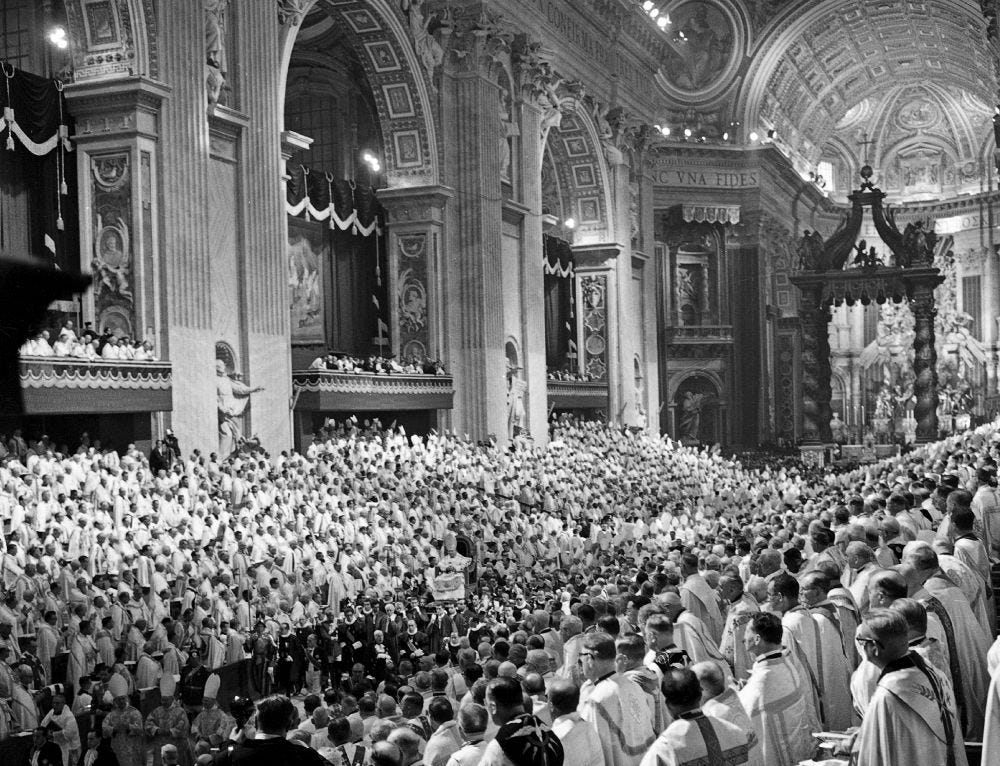
The Second Vatican Council mentions Saint Thomas in two separate documents. The first, Optatam Totius, does so in treating of the curriculum for theological studies. It says:
“Dogmatic theology should be arranged in such a way that biblical themes are proposed first. The students should be shown what the Fathers of the Eastern and Western Church have contributed to the faithful interpretation and transmission of each of the truths of Revelation, as well as the later history of Dogma, taking into account its relationship with the general history of the Church. Then, in order to clarify the mysteries of salvation as perfectly as possible, they should learn to penetrate them more deeply by speculation, having St. Thomas as their guide, and to see the connection existing between them.”
The second document, Gravissimum Educationis, is less relevant, but, for the same reason, more impressive. And the reason is that, unlike the previous document, this one refers not only to Theology, but to all subjects. It says:
“The Church also pursues with zealous care schools of a higher level, especially Universities and Faculties. Furthermore, in those which depend on her, she systematically seeks to have each discipline cultivated according to its own principles, its own method, and its own liberty of scientific inquiry, in such a way that an ever deeper understanding of them may be obtained, and, by carefully considering the new questions and investigations of the present age, it may be more profoundly seen how faith and reason harmoniously converge upon the single truth, following the footsteps of the doctors of the Church, especially St. Thomas Aquinas.”
Now, as the reader may have come to realize, a pervasive assumption seems to exist among some members of the Catholic Church today that the Second Vatican Council somewhat “watered down” the previous magisterial claims made by the Roman Pontiffs. I shall readily concede to my reader that the language is somewhat less forceful than what we grew accustomed to in the previous lectures.
However, two things ought to be noticed. First, that the tone of a later magisterial claim does not cancel out the earlier claims. Secondly, that, even if these claims may seem less strong and binding than what we had previously studied, however, that does not seem to be the interpretation of Pope Saint Paul VI, who presided over the Council. For he says, in his letter Lumen Ecclesiae:
“The Second Vatican Council itself recommended St. Thomas twice to Catholic schools. [...] It is, thus, the first time that an Ecumenical Council recommends a theologian, and that is St. Thomas.”
This letter, written in 1974, to celebrate the 700th anniversary of Saint Thomas’ death, is highly deserving of a full reading. Not having here the space to do so, I propose nonetheless a long quote, without further comments.
“Beyond the historical-cultural context in which St. Thomas lived, his figure emerges to position itself on a plane of the doctrinal order, which transcends the historical periods succeeding one another from the 13th century to our time. The Church, in these centuries, has recognized the permanent value of St. Thomas’s doctrine [...]. Our Predecessors and We ourselves have several times reaffirmed this validity. It is not a matter — let it be clearly understood — of a conservatism closed to the meaning of historical development and fearful of progress, but of a choice based on objective and intrinsic reasons within the philosophical and theological doctrine of St. Thomas, which allow us to recognize in him a man granted to the Church not without a higher design, who, with the originality of his creative work, determined a decisive turning point in the history of Christian thought and primarily in the relationship between intelligence and faith.”
Then, after recalling, as I have mentioned above, that the Second Vatican Council was the first to commend a doctor, and that the doctor who was commended was Saint Thomas, the Holy Father continues:
As for Us, it is sufficient to recall, among other things, what we once stated: «Those entrusted with the task of teaching should listen with reverence to the voice of the Doctors of the Church, among whom St. Thomas occupies the principal place; so great is, in fact, the power of the Angelic Doctor’s genius, his sincere love for truth, his wisdom in investigating the highest Truths, in illustrating them, and in linking them in a profound coherence, that his doctrine is the most effective instrument, not only to secure the foundations of the Faith, but also to extract in a useful and safe way the fruits of sound progress.»”2
The Catechism and the Code of Canon Law
After Saint Paul VI, the Church was governed by Saint John Paul II, whom many of us still remember, and whose memory many of us still cherish. Now, in his long pontificate, Pope Saint John Paul II promulgated two important documents. The first was the new Code of Canon Law. Canon 253 § 3, drawing from the Conciliar text mentioned above, regarding the formation of seminarians, establishes the following.
“There shall be classes in dogmatic theology, always based on the written word of God, together with sacred Tradition, with the help of which students may learn to penetrate more intimately the mystery of salvation, having St. Thomas principally as their master.”
The second important document promulgated by Pope Saint John Paul II was, of course, the Catechism of the Catholic Church. And, while the Catechism does not explicitly commend Saint Thomas, it nonetheless so repeatedly references him, that the commendation is very clear, even if implicit.
And, because the following is an objection to the authority of Saint Thomas which I have frequently heard, may the reader indulge me a couple of paragraphs on the topic. The objection (never fully formalized) is based on the fact that the Catechism quotes Saint Augustine more times than it quotes Saint Thomas. The tacit alleged inference seems to be that, therefore, Saint Thomas does not have much authority. Of course, I do not deny that Saint Augustine is quoted more often. But that is only natural, as Saint Augustine is an early Church Father — for what it is worth, Saint Thomas quotes Saint Augustine more than he quotes Saint Thomas. The Catechism’s quotations of Saint Augustine would only diminish Saint Thomas’ authority if Saint Augustine were quoted as an authority against Saint Thomas. Of course, that never happens. In fact, I have never run across an instance of the Catechism referencing Saint Augustine in a matter in which Saint Thomas disagrees with him. Thus, the number of references to Saint Augustine is in no way a sign of indifference to Aquinas, nor even of an alleged diminished authority.
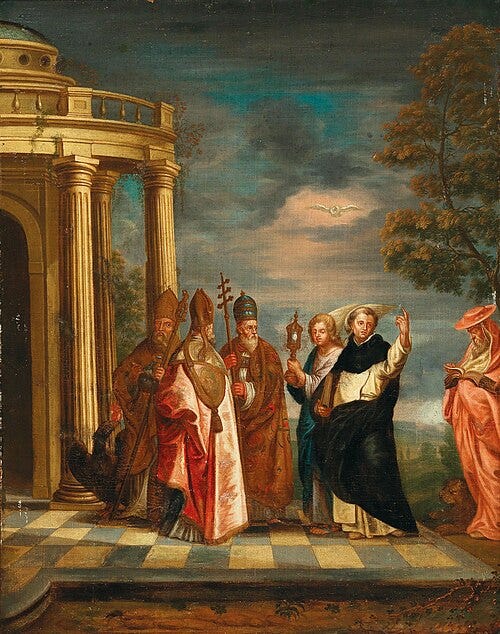
Quite to the contrary, everyone who is familiar with both Saint Thomas’ writings and the Catechism, will notice many, many passages in which the Catechism, albeit not explicitly referencing Saint Thomas, is nonetheless teaching the doctrine of Saint Thomas. And this, it seems to me, speaks supremely of Saint Thomas’ authority: the Church can simply teach his doctrine without referencing him; because, as we have seen in previous lectures, the Church has made Saint Thomas’ doctrine her own.
Fides et Ratio
Now, as I had said, besides those two documents, Pope Saint John Paul II (who, for the record, attained his doctorate at the Pontifical University of Saint Thomas Aquinas) praised Saint Thomas directly on many occasions.3 Here, I recall only his encyclical Fides et Ratio. He says:
“The Church has been justified in consistently proposing Saint Thomas as a master of thought and a model of the right way to do theology. [...] Profoundly convinced that omne verum a quocumque dicatur a Spiritu Sancto est (whatever its source, truth is of the Holy Spirit), Saint Thomas was impartial in his love of truth. He sought truth wherever it might be found and gave consummate demonstration of its universality. In him, the Church’s Magisterium has seen and recognized the passion for truth; and, precisely because it stays consistently within the horizon of universal, objective and transcendent truth, his thought scales “heights unthinkable to human intelligence”.
And, against any stain of “hermeneutics of discontinuity,” he writes:
[Pope Leo XIII’s Aeterni Patris] remains to this day the one papal document of such authority devoted entirely to philosophy. […] More than a century later, many of the insights of his Encyclical Letter have lost none of their interest from either a practical or pedagogical point of view — most particularly, his insistence upon the incomparable value of the philosophy of Saint Thomas. A renewed insistence upon the thought of the Angelic Doctor seemed to Pope Leo XIII the best way to recover the practice of a philosophy consonant with the demands of faith. […]
The positive results of the papal summons are well known. Studies of the thought of Saint Thomas and other Scholastic writers received new impetus. Historical studies flourished, resulting in a rediscovery of the riches of Medieval thought, which until then had been largely unknown; and there emerged new Thomistic schools. With the use of historical method, knowledge of the works of Saint Thomas increased greatly, and many scholars had courage enough to introduce the Thomistic tradition into the philosophical and theological discussions of the day. The most influential Catholic theologians of the present century, to whose thinking and research the Second Vatican Council was much indebted, were products of this revival of Thomistic philosophy. Throughout the twentieth century, the Church has been served by a powerful array of thinkers formed in the school of the Angelic Doctor.
The Three Most Recent Popes
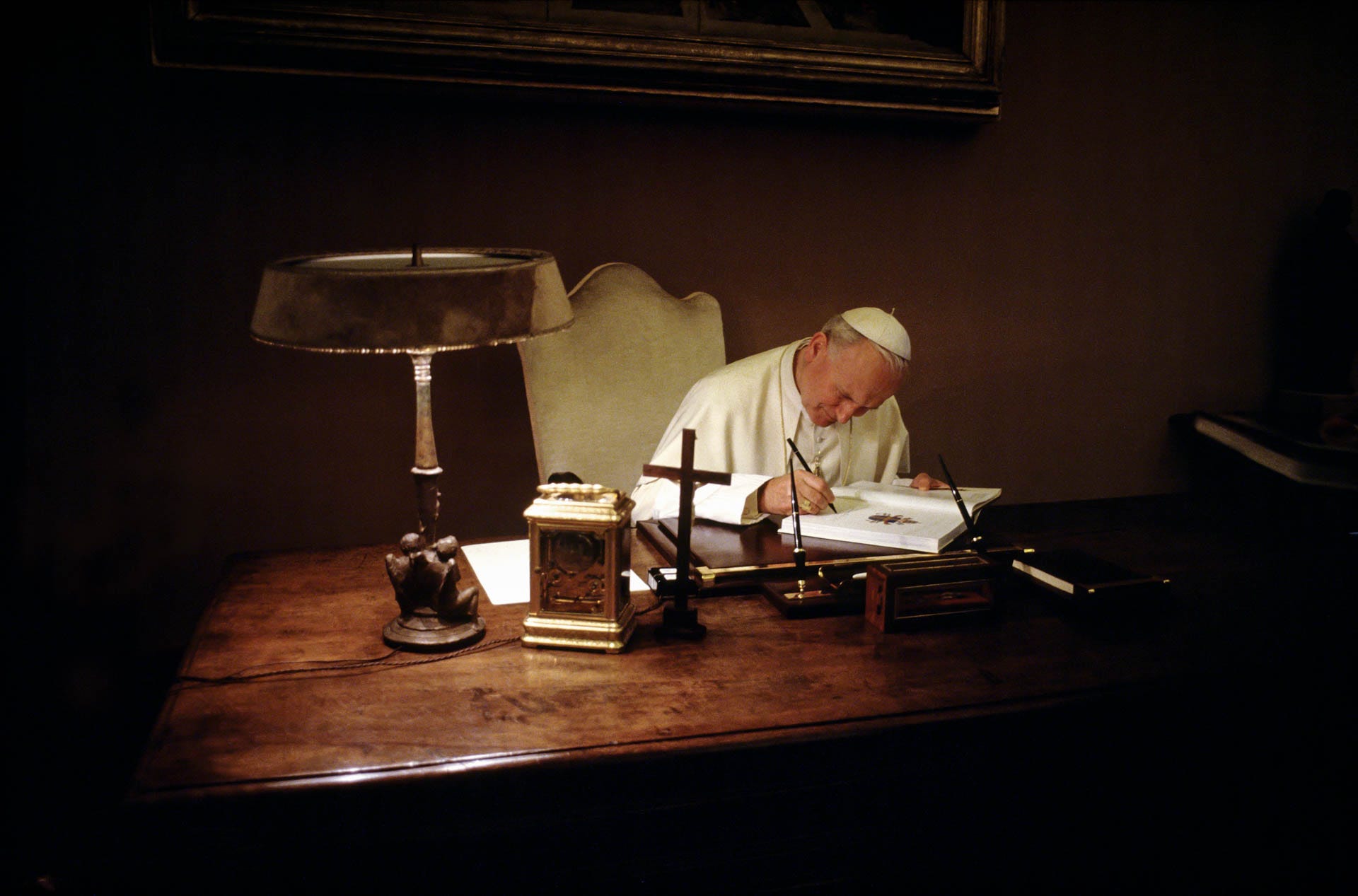
Truth be told, the last three Popes have not spoken very intensively of Saint Thomas, and less still of his authority. Of course, there is no need for later Pontiffs to constantly repeat such a beaten point.
Pope Benedict XVI reigned between 2005 and 2013. In 2010, he gave three general audiences on Our Doctor. These highly commented on the Saint’s work. And, while they made no new declarations of his authority, they acknowledged those made by Pope John Paul II and Pope Paul VI. So, for instance, Pope Benedict says:
“In his Encyclical Fides et Ratio, my venerable Predecessor, Pope John Paul II, recalled that “the Church has been justified in consistently proposing St Thomas as a master of thought and a model of the right way to do theology.”
At another moment, he says:
“My Predecessor, Pope Paul VI, also said this, in a Discourse he gave at Fossanova on 14 September 1974 on the occasion of the seventh centenary of St Thomas’ death. He asked himself: “Thomas, our Teacher, what lesson can you give us?”. And he answered with these words: “trust in the truth of Catholic religious thought, as defended, expounded and offered by him to the capacities of the human mind.” In Aquino, moreover, on that same day, again with reference to St Thomas, Paul VI said, “all of us who are faithful sons and daughters of the Church can and must be his disciples, at least to some extent!” Let us too, therefore, learn from the teaching of St Thomas.
Pope Francis reigned between 2013 and 2025. In the Syllabus to this Course, I have already provided my reader with a long quote of this Supreme Pontiff. In it, Pope Francis praises Saint Thomas, and warns against the risks of using the Master, rather than putting oneself at his feet — which, of course, implies that one ought to put oneself at the feet of Saint Thomas.
That was only one of several references made to Saint Thomas. In fact, if one reads through Pope Francis’ magisterial documents attentively, one is bound to notice how frequently he references Aquinas’ Summa Theologiae.
Another memorable reference to Saint Thomas was made in 2023, in a letter to Cardinal Marcello Semeraro. In it, Pope Francis nominates him as his official legate to the triennial celebrations that the Church lived between 2023 and 2025. The letter commends Saint Thomas, by saying, for instance, that:
Filled with the spirit of intelligence from the Most High, Saint Thomas Aquinas, priest and Doctor of the Church, learned without deceit and shared his outstanding wisdom with others without envy through his prayers and writings.
Furthermore, it instructed Cardinal Semeraro to speak “of this eminent man of the Church and his immense spiritual and human wisdom.”
Pope Leo XIV, as the reader surely knows, has reigned over the Church since 2025. Himself, as Pope John Paul II, a former student of the Pontifical University of Saint Thomas Aquinas, Pope Leo has not yet any memorable reference to Saint Thomas Aquinas. I myself am aware only of a couple brief references to Our Doctor during his audience on January 28th 2026.
God alone knows, and time will tell, what the Pontiff may come to say.
Others try to sell you cheap Thomism.
I’m offering you grounded, rigorous, living, and respectable Thomism.
Grounded, because, rather than an a priori abstraction, it resolves back into reality. Rigorous in its scholastic method. Living, because it didn’t die in the 13th century, but lives on to our days in its rich tradition. And respectable, because in this way it is equipped to achieve the truth.
The way to achieve it is the following.
Thorns and thistles; toil and tears; constant thirst, and thraldom to reality.
Consider supporting this work.
In today’s lecture, we have considered Saint Thomas’ authority since the Second Vatican Council. This closes our exposition of Our Doctor’s authority. Next week, we will start a new multiple-part exposition on his heritage to the Church — that is, Thomism.
Gonçalo Costa
The Respectable Thomist
Bibliography
If the reader wishes to go deeper in these topics, he may consider — besides the Magisterial Documents mentioned above — the following works. I was unable to find them for sale, but the reader can easily find them online.
“Introducción,” from the BAC edition of the Summa Theologiae, written in Spanish, by Fr. Santiago Ramírez, O.P.
De Auctoritate Doctrinali S. Thomae Aquinatis, by Fr. Santiago Ramírez. Originally in Latin, but translated to English here.
Sanctus Thomas Aquinas “Doctor Communis” Ecclesiae, written in Latin, by Fr. Joachim Joseph Berthier, O.P.
St. Paul VI (1963–1978); Bl. John Paul I (1978); St. John Paul II (1978–2005); Benedict XVI (2005-2013); Francis (2013–2025); and Leo XIV (2025–), who still reigns in the Chair of Peter. Only Blessed John Paul I, whose pontificate was so brief, did not commend the doctrine of Saint Thomas.
The Holy Father is referencing an allocution of his own, delivered at the Pontifical Gregorian University in 1964.
One of the most striking documents from Pope Saint John Paul II regarding Saint Thomas was Inter Munera Academiarum, an apostolic letter about the Pontifical Theological Academies. But we will return to it in a later lecture, when we consider the history of Thomism.
JP II was such an inspiration to me! I need to go back and read his classic encyclicals